Pebble Steel and the Strap Adapter Problem
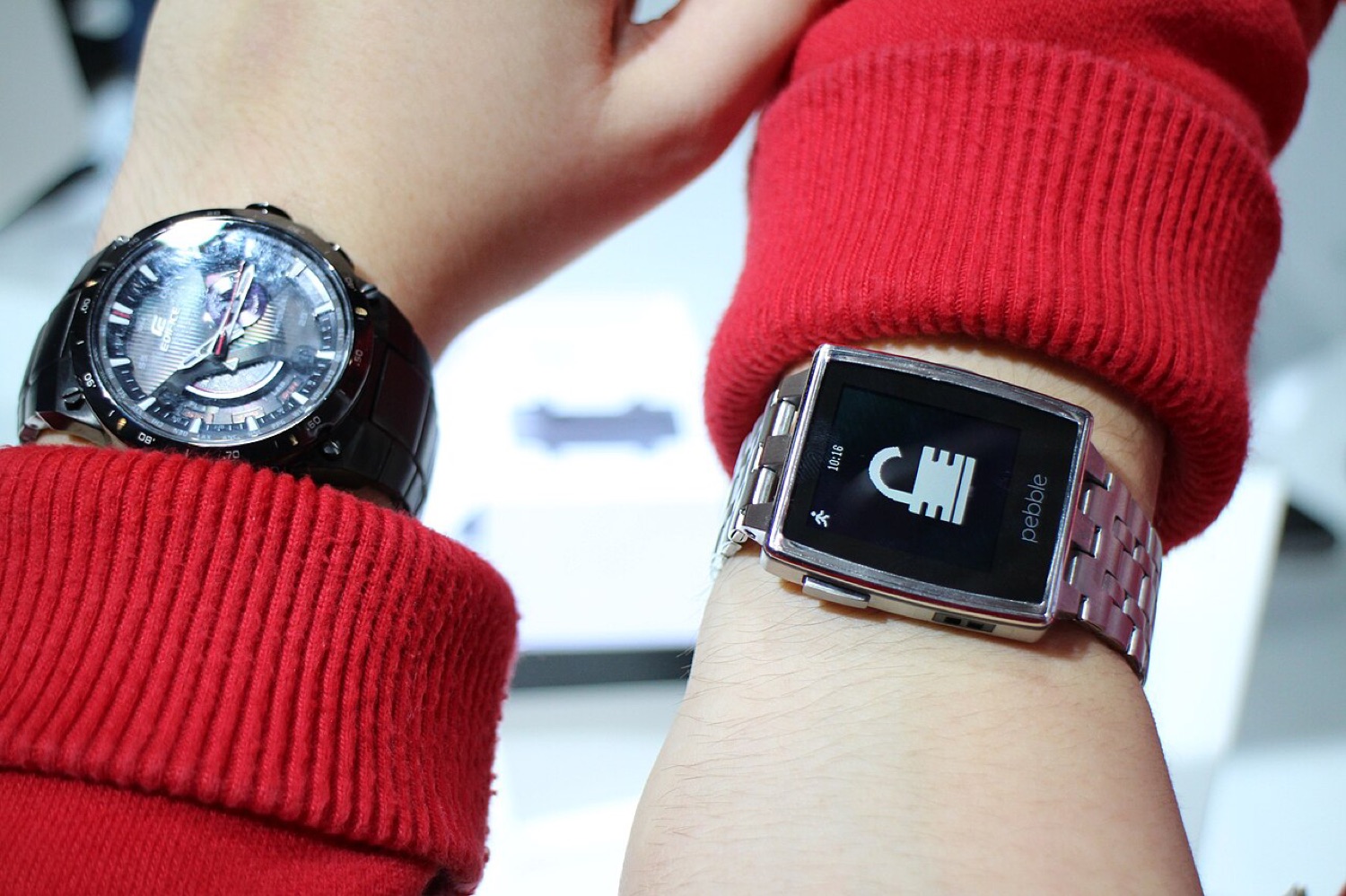
Why one of the first stylish smartwatches would not take an ordinary 22 mm strap, and how small machined adapters solved it.
Section: Pebble Steel Strap Adapter
Published:
Reading time: about 2 minutes
By the Steel Connect Journal editors
When Pebble showed the Pebble Steel in January 2014, it was one of the first smartwatches that looked like it belonged with a shirt and jacket rather than a gym bag. The case was stainless steel, brushed or matte black, and the watch came with both a leather strap and a metal bracelet. It sold well to people who liked the e-paper screen and the week-long battery life but wanted something less plasticky than the original Pebble.
There was one catch that owners noticed within days: the strap.
A proprietary connection
Most mechanical and quartz watches attach their straps with spring bars between two lugs, and the distance between those lugs (18, 20, 22 or 24 mm) decides which straps fit. The Pebble Steel did not use that arrangement in the usual way. Its straps met the case through a shaped, proprietary joint, so a normal 22 mm strap from a watch shop either would not fit at all or left an ugly gap against the case. Owners who wanted a NATO strap, a different leather or a third-party bracelet were stuck.
Where the adapters came in
Small makers spotted the gap quickly. The idea behind a strap adapter is simple: a machined metal piece fills the watch's own attachment point on one side and offers standard spring bar holes on the other. Fit one at each end of the case and the watch suddenly accepts the whole world of ordinary straps. The original SteelConnect was one of these accessories, funded through Kickstarter in 2014 by a few hundred Pebble Steel fans, and finished in brushed silver, matte black and anodised colours.
A good adapter has to get three things right:
- Fit at the case. Even a fraction of a millimetre of play shows up as a rattle or a visible gap.
- Finish. Brushed steel next to a brushed steel case looks intentional; a mismatched sheen looks like a repair.
- Hole position. Drill the spring bar holes too far out and the strap sticks out stiffly; too far in and the strap rubs the case.
The broader lesson
The Pebble Steel's strap problem became a template for the whole smartwatch business. Almost every early maker tried a clever proprietary attachment, and almost every one created a market for adapters. Pebble itself switched to standard 22 mm quick-release pins on the Pebble Time Steel in 2015, which is now the default on most round watches. We explain how those pins work in our guide to spring bars.
Crowdfunding an accessory for a single watch model was always a calculated bet: if the watch sold well, the adapter had a market; if the watch faded, so did the accessory. Pebble Steel owners still hunting for adapters in 2026 will mostly find them second-hand, which is one more reason to check how a strap attaches before you fall for a watch.


